

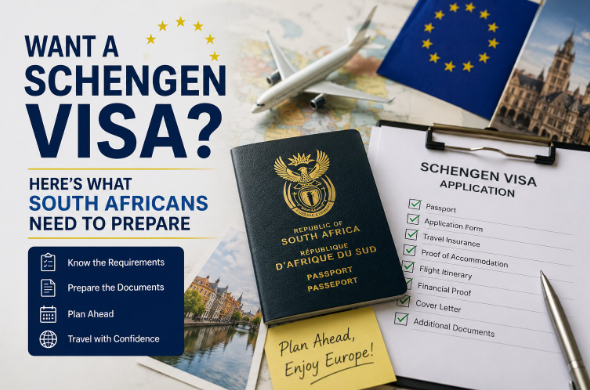
Planning a European holiday can be exciting, but preparing a Schengen visa application can feel overwhelming if you are unsure which documents you need. For South African citizens planning to visit countries in the Schengen Area, preparing the correct paperwork, meeting appointment requirements, and demonstrating the purpose of your trip are important parts of the application process.
Understanding the Schengen visa requirements South Africa applicants need to meet can make the process more organised and help you avoid common documentation mistakes.
What Is a Schengen Visa?
A Schengen visa generally allows eligible travellers to visit countries within the Schengen Area for short stays, subject to the conditions of the visa issued.
South African passport holders generally need a visa for short stays in the Schengen Area. EU rules specify that nationals of countries listed in Annex I of the EU Visa Regulation require a visa to cross the external borders of Schengen Member States.
The correct application process depends on your destination and the purpose of your trip. Before preparing documents, determine which Schengen country’s consulate or authorised visa application centre is responsible for your application.
Schengen Visa Requirements South Africa: What Should You Prepare?
Although the exact checklist can differ depending on the destination country and your circumstances, applicants should generally be prepared to provide several key documents.
1. Valid Passport
Your passport is one of the most important documents in your application. Make sure it meets the applicable Schengen requirements and has sufficient validity and blank pages.
You should also provide copies of relevant passport pages when requested.
2. Completed Visa Application Form
A correctly completed and signed visa application form is required. Under the EU Visa Code, applicants must submit a completed application form and, where applicable, provide fingerprints and supporting documents.
Check every field carefully before submitting the form. Differences between your application form, passport, travel bookings, and supporting documents can create questions during the assessment.
3. Recent Passport Photograph
Applicants generally need to provide photographs that meet the relevant Schengen visa specifications.
Do not assume that any standard passport photograph will automatically be accepted. Check the current requirements of the relevant consulate or visa application centre before submitting your application.
4. Travel Medical Insurance
Travel medical insurance is an important part of a Schengen visa application. EU rules require applicants, where applicable, to provide proof of adequate and valid travel medical insurance.
The policy should meet the requirements specified for your visa application, including the required geographical coverage and minimum coverage level.
5. Proof of Accommodation
Applicants may need to demonstrate where they will stay during their trip. Depending on your circumstances, this could include hotel reservations, accommodation confirmations, or documents relating to staying with a host.
Make sure your accommodation details are consistent with your planned itinerary.
6. Proof of Travel Plans
Your application should clearly explain your intended trip. Supporting evidence may include a proposed itinerary, flight reservations, or other travel documentation requested by the relevant consulate.
Avoid creating inconsistencies between your travel dates, accommodation, leave dates, and other supporting documents.
Showing Proof of Financial Means
One of the important parts of a Schengen application is demonstrating that you can financially support yourself during your trip.
Applicants may be asked to provide documents such as recent bank statements, payslips, employment information, or other evidence of financial circumstances.
The exact financial requirement can vary depending on the destination country and length of stay. Therefore, applicants should follow the checklist provided by the relevant consulate rather than relying on a generic online checklist.
Proof of Employment or Strong Ties to South Africa
Applicants may also need to demonstrate their circumstances in South Africa and provide evidence supporting their intention to return after the trip.
Depending on your situation, this could include:
- An employment confirmation letter
- Approved leave from your employer
- Recent payslips
- Business registration documents if self-employed
- Proof of studies if you are a student
- Evidence of family or other relevant commitments
The purpose is to provide a clear and consistent picture of your circumstances and travel plans.
Do You Need a Police Clearance Certificate for a Schengen Visa?
This is an area where applicants often become confused.
A Police Clearance Certificate is not automatically required for every standard Schengen short-stay tourist visa application. Requirements depend on the visa category, destination country’s rules, and the applicant’s individual circumstances.
If the relevant authority specifically requests a PCC, applicants should obtain the correct certificate and check whether it needs additional authentication, legalisation, or translation.
South African Police Service guidance states that a Police Clearance Certificate confirms whether criminal convictions have been recorded against an individual and is available for purposes including emigration, travel, or employment abroad.
Can You Request a Police Clearance Certificate Online?
Applicants searching for police clearance certificate online services should distinguish between checking an application online and completing the entire PCC process digitally.
SAPS provides an online facility for checking the status of a Police Clearance Certificate application. However, the application itself requires fingerprints and supporting documents. SAPS states that fingerprints are required and that scanned versions of fingerprints are not processed.
This means applicants should not assume that an online form or online enquiry replaces the fingerprint and document requirements.
Biometrics and Your Visa Appointment
Depending on your circumstances and previous biometric records, you may need to attend an appointment to provide fingerprints and other biometric information.
Your visa application centre will provide instructions regarding what you need to bring. Applicants should carefully follow the specific checklist provided for their destination country.
Do not wait until the appointment day to discover that an important document or copy is missing.
Common Mistakes South African Applicants Should Avoid
Even a well-prepared application can run into problems if documents are inconsistent or incomplete. Some common mistakes include:
- Providing incorrect or inconsistent travel dates
- Submitting incomplete application forms
- Using accommodation details that do not match the itinerary
- Providing insufficient financial evidence
- Forgetting required insurance documentation
- Failing to provide translations where required
- Submitting documents that do not meet the specific consulate’s requirements
- Assuming every Schengen country uses exactly the same supporting-document checklist
The safest approach is to follow the current instructions of the consulate or authorised visa application centre responsible for your application.
How to Make Your Schengen Application More Organised
Start by creating a document checklist based on the requirements for your destination country.
Then organise your documents into categories such as:
Personal documents: passport, application form and photographs.
Travel documents: itinerary, accommodation and relevant travel bookings.
Financial documents: bank statements, payslips and proof of income.
Employment documents: employment letter, approved leave or business documents.
Additional documents: insurance, invitations, family documents, PCC, translations or other documents if specifically requested.
Review everything before your appointment and make sure the information is consistent across all documents.
Should You Get Professional Visa Assistance?
For applicants who are unsure about the documentation or application process, professional assistance can make the preparation process easier to manage.
A visa professional can help you understand the checklist, identify missing documents, review application information, and organise supporting paperwork. However, applicants should remember that the final visa decision is made by the relevant consular authority.
Professional assistance should complement—not replace—the official requirements provided by the relevant embassy or visa application centre.
Final Checklist Before Applying
Before submitting your Schengen visa application, ask yourself:
- Is my passport valid and suitable for the application?
- Have I completed and signed the application form correctly?
- Do my travel dates match across all documents?
- Have I prepared sufficient financial evidence?
- Do I have appropriate travel medical insurance?
- Have I provided accommodation and itinerary evidence?
- Have I checked whether any additional documents, such as a PCC, are specifically required?
- Have I checked the latest requirements of the relevant Schengen country’s consulate?
Taking time to review these details can help you submit a more complete and organised application.
Ready to Start Your Schengen Visa Application?
Planning your European trip from South Africa? A well-prepared application can make the visa process much easier. From your passport and application form to financial proof, travel insurance, accommodation, and supporting documents, getting everything organised correctly is an important first step.
Remember, Schengen visa requirements South Africa applicants need to meet can vary depending on your destination country, visa purpose, and personal circumstances. If a Police Clearance Certificate is specifically requested, make sure you follow the correct application process and provide the required documentation.
Need help preparing your Schengen visa application or arranging a police clearance certificate online? Contact Visa Logistics today for professional guidance with your visa and document requirements, and take the next step towards your European journey with confidence.
Key Takeaways
- Check the latest Schengen visa requirements South Africa before applying.
- Prepare your passport, application form, insurance, accommodation, financial proof, and travel documents.
- A PCC is only required when specifically requested by the relevant authority.
- Police clearance certificate online services do not replace fingerprint requirements.
- Always follow the checklist provided by the relevant consulate or visa centre.
Frequently Asked Questions
Q1. Do South Africans need a Schengen visa?
Yes, South African passport holders generally need a Schengen visa for short stays.
Q2. What documents are needed for a Schengen visa?
Common requirements include a valid passport, application form, travel insurance, accommodation proof, financial documents, and travel details.
Q3. Is a PCC required for a Schengen visa?
Not always. A PCC is required only if requested for your specific application.
Q4. Can I apply for a PCC online?
Some PCC services and status checks are available online, but fingerprint requirements still apply.
Q5. When should I prepare my visa documents?
Start early to allow enough time to collect documents, book appointments, and address any additional requirements.